


Many gamers assume consoles drive gaming innovation, but PC growth remains structurally supported, with steady player expansion underpinning sustained revenue growth. In 2026, PC gaming continues to outpace consoles in setting industry trends, shaping player experiences, and influencing popular culture. This platform’s unique combination of hardware flexibility, community-driven innovation, and diverse pricing models creates an ecosystem where groundbreaking ideas flourish. Understanding why PC games lead trends helps you recognize emerging gameplay mechanics, anticipate cultural shifts, and make informed decisions about where to invest your gaming time and budget.
Table of Contents
Key takeaways
| Point | Details |
|---|---|
| Steady growth advantage | PC gaming sustains consistent player base expansion and revenue growth, creating a stable foundation for trend leadership. |
| Diverse engagement patterns | Players increasingly explore games beyond top 20 titles, with engagement outside them rising from 33% to 42% between 2022 and 2025. |
| Hardware innovation leadership | Advanced PC components enable developers to push visual fidelity and gameplay complexity beyond console capabilities. |
| Community-driven experiences | User-generated content, frequent updates, and social events on PC platforms blur boundaries between games and cultural phenomena. |
| Flexible market dynamics | Mid-tier pricing ($30-$50) shows fastest growth, while budget titles under $30 empower indie innovation and player choice. |
Steady growth and shifting player engagement in PC gaming
PC gaming demonstrates remarkable consistency in expanding its player base, contrasting sharply with the cyclical boom-and-bust patterns typical of console generations. This structural advantage creates a predictable environment where developers can invest in long-term projects and experimental mechanics without fearing sudden market contractions. The platform’s steady player expansion supports sustained revenue growth, providing studios with the financial confidence to take creative risks that eventually become industry-wide trends.
Player engagement patterns reveal fascinating shifts in how gamers allocate their time. While top titles still command significant attention, engagement outside top 20 games grew from 33% to 42% between 2022 and 2025. This diversification signals a maturing market where players actively seek fresh experiences beyond blockbuster franchises. The trend benefits innovative indie developers and AA studios, creating a virtuous cycle where unique gameplay concepts gain traction and influence larger productions.
Premium PC games drive revenue growth with an increasing share of player spending, particularly in the $30-$50 price range. This sweet spot allows developers to deliver polished experiences without AAA budgets while maintaining healthy profit margins. The top PC games list showcases how quality titles across various price points attract dedicated audiences. Understanding game reviews importance helps you identify which emerging titles deserve your attention before they become mainstream phenomena.
The following table illustrates how PC player engagement has evolved:
| Metric | 2022 | 2025 | Change |
|---|---|---|---|
| Top 20 titles playtime share | 67% | 58% | -9% |
| Outside top 20 engagement | 33% | 42% | +9% |
| Premium game revenue share | 38% | 47% | +9% |
Pro Tip: Exploring games beyond top titles can uncover emerging trends and innovative gameplay mechanics months before they influence mainstream releases, giving you early access to fresh experiences and conversation topics within gaming communities.
PC hardware innovation fuels complex and visually stunning games
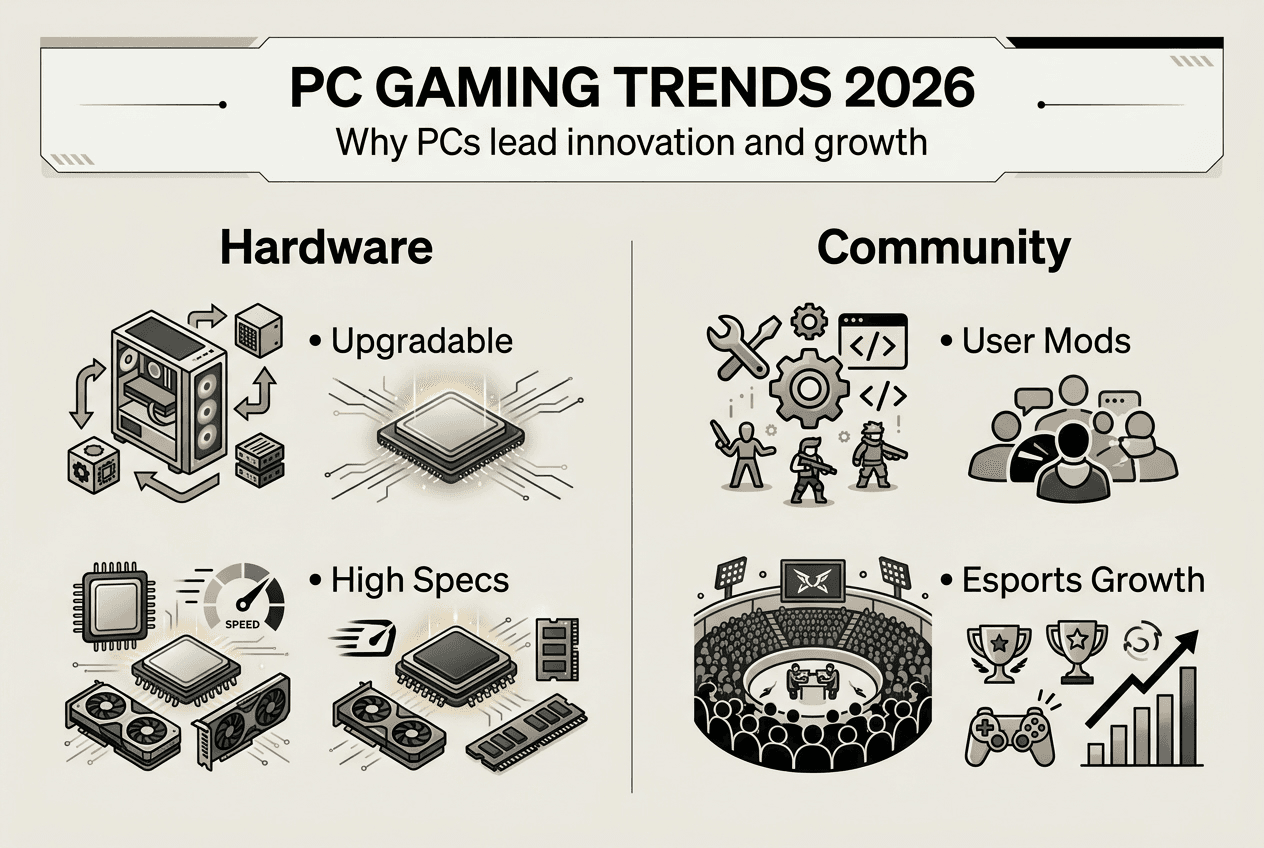
The rapid evolution of PC components creates a performance ceiling that console hardware cannot match between generational releases. Faster CPUs handle more complex AI behaviors and physics simulations, while cutting-edge GPUs render photorealistic environments at higher resolutions and frame rates. Increased RAM capacity allows developers to build expansive open worlds with minimal loading screens, fundamentally changing how players experience virtual spaces. These capabilities enable PC-first titles to establish visual and technical benchmarks that console ports later adapt.
High-end PC builds outperform current consoles in frame rates and resolution, supporting game designs that would be impossible on fixed hardware platforms. This performance advantage manifests in titles featuring destructible environments, advanced weather systems, and hundreds of simultaneous on-screen characters. Developers targeting PC can implement features knowing a segment of their audience possesses hardware capable of running these systems at optimal settings, pushing the entire industry forward.

The competitive PC market fuels continuous hardware and software innovations as manufacturers vie for enthusiast dollars. This competition benefits gamers through regular performance improvements and price reductions, making cutting-edge technology accessible to broader audiences. Graphics card manufacturers release new architectures annually, each generation introducing capabilities that enable novel rendering techniques and gameplay possibilities. These innovations trickle down to consoles in subsequent generations, proving PC’s role as gaming’s research and development laboratory.
Consider these performance comparisons:
| Specification | High-End PC (2026) | Current Console |
|---|---|---|
| Target resolution | 4K native | 4K upscaled |
| Average frame rate | 120+ fps | 60 fps (performance mode) |
| Ray tracing quality | Full global illumination | Selective implementation |
| Loading times | Near instant (NVMe) | 2-5 seconds |
Staying current with gaming hardware guide information lets you fully experience cutting-edge games and experimental modes that showcase tomorrow’s standard features. Understanding gaming updates importance helps you optimize your system for maximum performance as developers refine their implementations.
Pro Tip: Monitor hardware release cycles to time upgrades strategically, purchasing previous-generation components at steep discounts when new models launch while still enjoying performance far exceeding console capabilities.
Community-driven innovation: how PC games shape player experiences and culture
PC games empower players to create and share content at scales impossible on closed platforms, fundamentally expanding game scope and social interaction. Modding communities transform single-player experiences into ongoing collaborative projects, adding features, storylines, and mechanics that developers never envisioned. This participatory culture turns players into co-creators, fostering deep emotional investment and extending game lifespans far beyond initial release windows. The most successful mods often inspire official features in sequels or spawn entirely new genres.
Fortnite’s evolution with Creative Mode and UEFN demonstrates PC’s power to democratize game creation and foster community engagement. Players build custom game modes, social spaces, and interactive experiences that attract millions of participants, effectively creating a platform within a platform. This meta-layer of creativity generates viral trends that spill into mainstream culture, from dance emotes to virtual concerts. The PC version’s superior tools and performance make it the preferred platform for serious creators.
Iterative development and frequent updates keep communities engaged while sparking new trends that ripple across the industry. Developers can deploy patches, balance changes, and content additions rapidly on PC, responding to player feedback in near real-time. This agility enables experimental features to reach audiences quickly, with successful innovations spreading to other games within months. The continuous evolution model contrasts sharply with console development’s traditionally rigid schedules, making PC the proving ground for live service mechanics.
The Fortnite Marshmello concert represented a transformative cultural moment where 10.7 million concurrent players gathered for a shared virtual experience, demonstrating gaming’s potential as a social platform rivaling traditional media.
Key ways community features influence trends:
- User-generated content extends game longevity and creates unexpected viral moments that attract new players and media attention.
- Large-scale social events blur boundaries between games and entertainment platforms, establishing new expectations for interactive experiences.
- Continuous updates based on community feedback create responsive ecosystems where player voices directly shape game evolution.
- Platform loyalty driven by Steam’s dominance and established user bases creates network effects that amplify successful trends.
Understanding esports growth factors reveals how PC gaming’s community features translate competitive play into cultural phenomena that influence game design across all platforms.
Pricing and market dynamics boosting PC’s leading role
PC’s flexible pricing structure supports diverse game offerings that cater to every budget and preference, creating a healthy ecosystem where experimental titles thrive alongside blockbusters. The $30-$50 price tier shows fastest growth, with titles under $30 growing 156% for new releases in 2025. This mid-tier sweet spot allows developers to deliver polished experiences without AAA marketing budgets, reducing financial risk while maintaining creative freedom. Players benefit from high-quality games at accessible prices, encouraging experimentation with unfamiliar genres.
Lower-priced games under $30 increasingly dominate new release volume, supporting indie and AA studios that drive innovation through necessity. These developers cannot compete on graphics budgets, forcing them to differentiate through novel mechanics, compelling narratives, or unique art styles. Many gameplay innovations that later appear in AAA titles originate in these budget-conscious productions, proving that constraints breed creativity. Digital distribution eliminates manufacturing and retail costs, making low-price strategies financially viable.
The competitive PC market encourages diverse offerings and consumer choice through multiple storefronts competing for player attention and developer partnerships. This competition manifests in exclusive deals, generous revenue splits, and platform features that benefit both creators and consumers. Unlike console ecosystems controlled by single manufacturers, PC’s open nature prevents any entity from dictating terms, fostering an environment where merit and player preference determine success.
| Price Tier | PC Growth Rate (2024-2025) | Console Growth Rate (2024-2025) | Market Impact |
|---|---|---|---|
| Under $30 | +156% | +78% | Indie innovation hub |
| $30-$50 | +89% | +34% | Fastest-growing premium segment |
| $50-$70 | +23% | +45% | Traditional AAA space |
| Over $70 | +12% | +8% | Collector/deluxe editions |
How pricing flexibility fosters innovation:
- Digital distribution eliminates physical production costs, allowing developers to experiment with unconventional pricing models like pay-what-you-want or episodic releases.
- Frequent sales and bundles expose players to genres they might otherwise ignore, broadening tastes and creating demand for niche experiences.
- Early access programs let developers fund development through player purchases while gathering feedback, reducing publisher dependence and creative compromise.
- Regional pricing makes games accessible in emerging markets, expanding the player base and cultural perspectives that influence future designs.
Exploring game cheat codes guide resources helps you maximize value from budget purchases by extending replayability and discovering hidden content.
Explore PC gaming trends and insights with PCMobileGames
Deepen your understanding of PC gaming’s evolving landscape through comprehensive resources designed for enthusiasts seeking competitive advantages and insider knowledge. Our gaming hardware guide breaks down component choices, helping you build systems optimized for current and upcoming titles without overspending on unnecessary specifications. Understanding hardware fundamentals empowers smarter purchasing decisions aligned with your gaming priorities.
Stay ahead of industry shifts by exploring why gaming updates matter for gameplay quality and community engagement. Regular updates introduce balance changes, new content, and performance optimizations that fundamentally alter competitive landscapes and player experiences. Recognizing update patterns helps you anticipate meta shifts and adapt strategies before competitors catch on.
Gain competitive edges through our safely curated game cheat codes guide, offering legitimate methods to unlock hidden features and experimental modes. These resources help you experience games from fresh perspectives while avoiding risky third-party tools that compromise system security or violate terms of service.
Frequently asked questions
What makes PC gaming platforms unique compared to consoles?
PC platforms offer open ecosystems where multiple storefronts compete, hardware upgrades occur incrementally rather than generationally, and players control their experience through extensive customization options. This flexibility enables rapid adoption of new technologies and experimental features without waiting for manufacturer approval or hardware refresh cycles.
How do PC games foster more innovation?
Lower barriers to entry allow independent developers to publish directly to audiences without publisher gatekeeping, while modding communities extend game capabilities in unexpected directions. The platform’s technical superiority lets developers implement cutting-edge features knowing enthusiast hardware can support them, establishing benchmarks other platforms later adopt.
Why do community features matter so much in PC gaming?
PC’s open architecture supports robust communication tools, content creation pipelines, and social features that transform games into persistent communities rather than isolated experiences. User-generated content and frequent developer interaction create feedback loops where player creativity directly influences game evolution, fostering deeper engagement and cultural relevance.
How does pricing on PC games influence player choice?
Flexible pricing from under $10 to over $70 lets players match purchases to budgets and risk tolerance, encouraging experimentation with unfamiliar genres. Frequent sales and bundle deals expose gamers to diverse titles they might otherwise skip, broadening tastes and creating demand for innovative mechanics that influence mainstream productions.
What role does hardware advancement play in PC gaming trends?
Rapid component evolution establishes performance ceilings that enable complex simulations, photorealistic graphics, and massive multiplayer experiences impossible on fixed console hardware. These capabilities let developers push creative boundaries, with successful innovations eventually trickling down to console adaptations in subsequent generations, proving PC’s role as the industry’s experimental laboratory.
Why is player engagement shifting away from top titles?
Maturing audiences seek fresh experiences beyond familiar franchises, while improved discoverability tools help niche titles find dedicated audiences. The success of mid-tier and indie games demonstrates that compelling gameplay and novel concepts can compete with AAA marketing budgets, encouraging developers to take creative risks that spawn new trends.
Recommended
- Stay Updated on Gaming News: 60% More Coverage in 2026
- Why gaming updates matter for gameplay in 2026
- Why Game Reviews Matter: 70% Gamers Choose Smarter in 2026
- Role of esports in gaming: impact and trends in 2026
Comments
0 comments

