

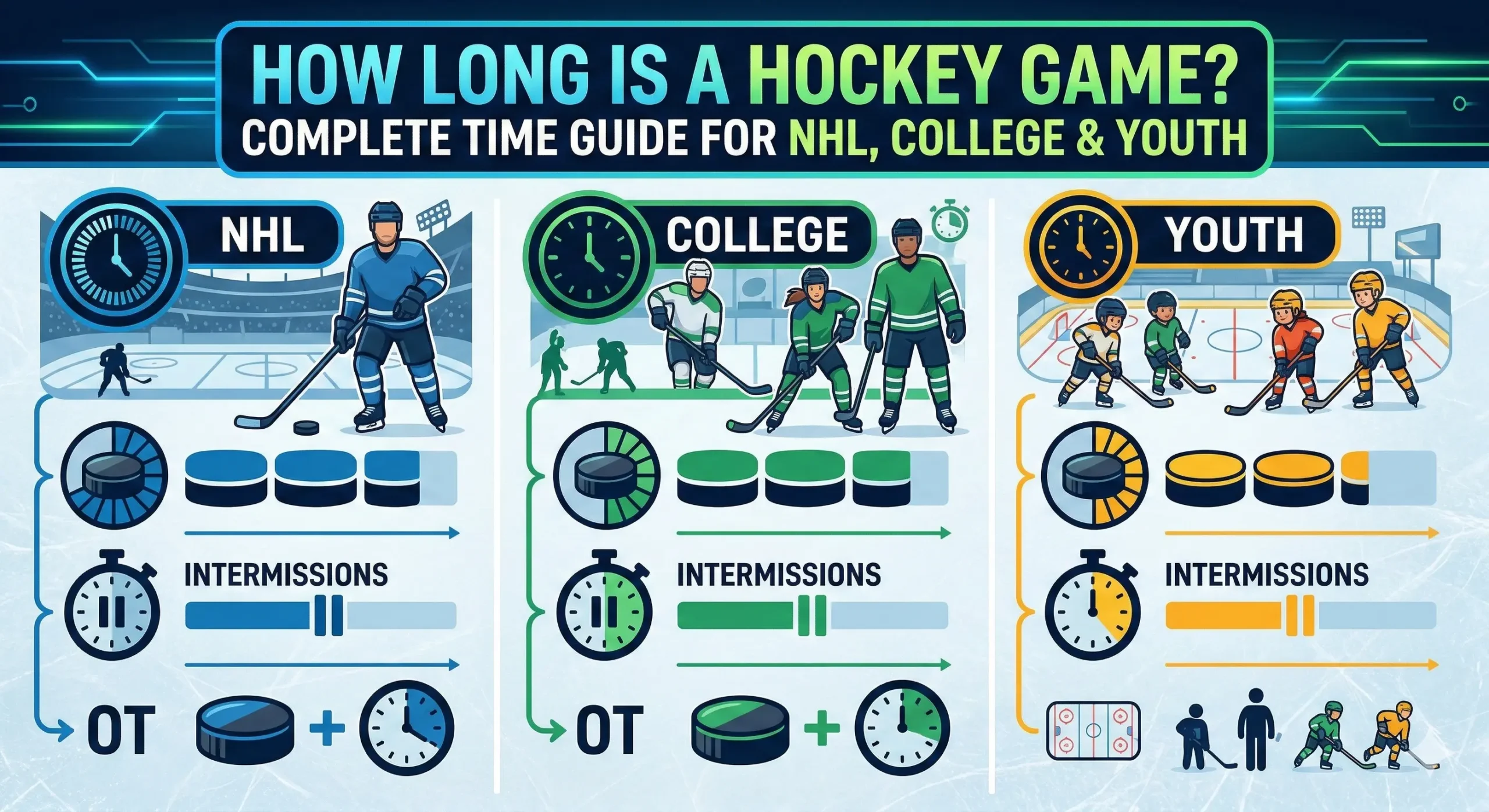
TL;DR: A regulation NHL hockey game consists of three 20-minute periods — 60 minutes of actual playing time. But with stoppages, intermissions, TV timeouts, and potential overtime, the real-world clock runs closer to 2.5 to 3 hours for most games. Playoffs? Budget for longer. Youth hockey? Much shorter.
If you’ve never watched hockey before and someone invites you to a game, you’re probably doing the mental math right now. Can I make dinner plans after? Do I need to clear my whole evening? Is this a baseball-length commitment or a halftime-and-done situation?
Good news. Hockey is actually one of the more time-predictable major sports. Once you understand how the clock works — and why it doesn’t work the way you’d expect — the whole thing makes a lot more sense.
How Long Is a Regulation NHL Hockey Game?
A regulation NHL hockey game lasts 60 minutes of actual playing time, divided into three 20-minute periods. With two intermissions of approximately 17 minutes each, TV timeouts, stoppages, and warm-ups, the total real-world duration averages 2 hours 30 minutes to 3 hours from puck drop to final buzzer.
Here’s the basic structure:
| Element | Duration |
|---|---|
| Period 1 | 20 minutes (game clock) |
| First Intermission | ~17 minutes |
| Period 2 | 20 minutes (game clock) |
| Second Intermission | ~17 minutes |
| Period 3 | 20 minutes (game clock) |
| Total Playing Time | 60 minutes |
| Total Real-World Time | ~2.5 to 3 hours |
The reason the 60-minute clock stretches to nearly three hours in real life is simple: the NHL clock stops every time play stops. Icing calls, penalties, injuries, puck out of play, goals, video reviews — every stoppage freezes the clock completely. That’s great for the quality of the game.
Less great if you have somewhere to be.
Know about: Horizon Zero Dawn Ancient Armory System Requirements
The Three Periods Explained
Hockey doesn’t use halves or quarters. Three periods of 20 minutes each — that’s the structure, full stop. Each period starts with a faceoff at center ice, and teams switch ends after the first and second periods. The Zamboni resurfaces the ice during both intermissions, which is partly why intermissions run as long as they do.
What Happens During Intermissions?
- Ice resurfacing by the Zamboni (takes 12–15 minutes alone)
- Player rest, coaching adjustments, and line strategy
- TV broadcast segments, analyst commentary, and commercials
- Fan entertainment at live games — contests, music, spotlight segments
- The clock doesn’t run — intermissions are a full stop in the action
Does Hockey Go to Overtime?
Yes. If the score is tied after three periods, NHL regular season games go to a 5-minute 3-on-3 sudden-death overtime period. If nobody scores, a shootout decides the winner. Playoff games use unlimited sudden-death overtime periods of 20 minutes each until a goal is scored — which can add hours to the game.
Regular Season Overtime
- Format: 5 minutes, 3-on-3 sudden death
- If still tied: Shootout (3 shooters per side, then sudden death rounds)
- Extra time added: Roughly 15–25 minutes total with intermission
Playoff Overtime
This is where things get genuinely unpredictable. Playoff OT is pure sudden death — full 20-minute periods, 5-on-5, no shootout, ever. The game ends the moment someone scores. Period.
- One OT period: Add ~40 minutes to total game time
- Two OT periods: Add ~80 minutes — you’re now past the 4-hour mark
- Three+ OT periods: Rare but legendary — the longest NHL playoff game ever went to 6 overtime periods in 1936 (176 minutes of overtime alone)
If you’re watching a Game 7 playoff match that goes to triple overtime — clear your schedule, order food, and embrace the chaos. That’s hockey at its absolute finest.
Also know:
Mount and Blade Warband Cheats & Mods
What Is Ucatruco? The Free Fire Guide
How Long Are Other Types of Hockey Games?
Not all hockey is NHL. Here’s how the duration changes across different levels of play:
College Hockey (NCAA)
- Structure: Three 20-minute periods — identical to NHL
- Overtime: 5 minutes, 3-on-3 sudden death in regular season; 20-minute sudden-death periods in playoffs
- Total real-world time: Approximately 2 hours 15 minutes to 2 hours 45 minutes
- Slightly shorter than NHL primarily due to fewer TV timeouts and tighter broadcast constraints
Minor League Hockey (AHL, ECHL)
- Same three-period, 20-minute structure as NHL
- Intermissions may be slightly shorter without major broadcast deals
- Total real-world time: Approximately 2 hours to 2 hours 30 minutes
Youth Hockey
Youth hockey varies significantly by age group — and thankfully, it’s much shorter:
| Age Group | Period Length | Total Playing Time | Real-World Duration |
|---|---|---|---|
| Mites (8U) | 12 minutes | 36 minutes | ~1 hour |
| Squirts (10U) | 15 minutes | 45 minutes | ~1.5 hours |
| Peewees (12U) | 15–17 minutes | 45–51 minutes | ~1.5–2 hours |
| Bantam/Midget (14U–18U) | 17–20 minutes | 51–60 minutes | ~2 hours |
Youth games also typically have shorter or no intermissions, and running-time clocks (clock doesn’t stop on every whistle) are common at younger age groups to keep things moving.
International Hockey (IIHF / Olympics)
- Same three 20-minute period structure as NHL
- Slightly different overtime rules depending on tournament stage
- Total real-world time: Approximately 2 hours 15 minutes to 2 hours 45 minutes
- Olympic games tend to run tighter due to strict broadcast scheduling
Women’s Hockey (PWHL / Olympic Women’s)
- Three 20-minute periods — same structure
- Total real-world time: ~2 hours to 2 hours 30 minutes
- Overtime format mirrors international or league-specific rules
Why Does Hockey Feel Faster Than Its Clock?
Here’s something interesting — most first-time hockey watchers say the game flew by compared to, say, a 3-hour baseball game or a 4-hour NFL Sunday. There’s a psychological reason for that.
Hockey is one of the few sports with almost zero natural dead time within play. When the clock is running, something is almost always happening — a rush, a battle along the boards, a shot, a save. There are no pitcher mound visits, no quarterback huddles, no timeouts every two minutes. The action-to-clock ratio is extremely high.
The stoppages that extend the real-world time happen between plays, not during them. So the experience feels tighter and more relentless than the raw numbers suggest.
Tips for First-Time Fans Attending a Live Game
- Arrive 20–30 minutes early — warm-ups are worth watching, and arena security lines move slowly
- Plan for 3 hours minimum — even if the game ends in regulation, parking and exiting the arena adds time
- Playoff games? Plan for 3.5–4+ hours — especially in elimination rounds where overtime is common
- Halftime equivalent = Second intermission — that’s when you grab food, stretch, and use the restroom
- Don’t leave early — hockey is statistically one of the highest-comeback sports; 3rd-period comebacks happen constantly
Expert Quotes
“The NHL game clock gives fans 60 minutes of the fastest, most intense team sport on the planet. But what makes hockey special is that those 60 minutes expand into a full evening’s worth of drama — especially come playoff time, when overtime periods can make a single game feel like an entire series compressed into one night.”
— Hockey analyst perspective, widely reflected across NHL broadcast commentary
“For youth hockey parents, the real question isn’t how long the game is — it’s how long the rink visit is. Factor in pre-skate warm-up, dressing time, the game itself, and undressing after, and a 45-minute Squirt game easily becomes a 2.5-hour commitment.”
— Youth hockey coaching community, widely cited in parent guides
Frequently Asked Questions
A regulation NHL hockey game takes approximately 2 hours 30 minutes to 3 hours in real time, despite having only 60 minutes on the game clock. The difference comes from two 17-minute intermissions, TV timeouts, penalty stoppages, icing calls, and other clock-stopping situations that extend the actual time spent in the arena or watching on TV.
Hockey is played in three periods of 20 minutes each, totaling 60 minutes of regulation play. Unlike football (4 quarters) or basketball (4 quarters), hockey uses three periods separated by two intermissions. Teams switch ends of the ice after the first and second periods, and the ice is resurfaced by a Zamboni during each intermission break.
NHL playoff overtime consists of full 20-minute sudden-death periods played 5-on-5. There is no shootout in the playoffs — the game continues until someone scores, no matter how long that takes. One overtime period adds roughly 40 minutes to total game time. Multiple overtime periods are not uncommon, and historically games have lasted over 6 overtime periods in extreme cases.
Youth hockey games are significantly shorter than NHL games. Mite (8U) games run about 1 hour total; Squirt (10U) games last about 1.5 hours; Bantam and Midget (14U–18U) games run closer to 2 hours. Many youth leagues also use running-time clocks at younger age groups, where the clock doesn’t stop on every whistle, keeping games shorter and more manageable.
A TV timeout is a scheduled stoppage in NHL games where play is paused to allow broadcasters to air commercials. They typically occur at the first whistle after the 6-minute, 10-minute, and 14-minute marks of each period — three per period, nine per game. TV timeouts add several minutes to total game time and are one of the main reasons NHL games run longer than pure clock time suggests.
On television, NHL regular season games are typically scheduled for 2.5 to 3-hour broadcast windows. Playoff games are scheduled for 3+ hours with open-ended overtime coverage. Most broadcasters leave their schedules flexible for playoff overtime, preempting whatever would normally follow the game. Streaming services like ESPN+ and TNT Sports show the full game regardless of length.
Each intermission in an NHL game lasts approximately 17 minutes. There are two intermissions — one after the first period and one after the second period. During this time, the Zamboni resurfaces the ice (taking 12–15 minutes), players rest in the locker room, and broadcasters air analysis segments and commercials. Intermissions at youth and amateur levels are often shorter.
College (NCAA) hockey games follow the same three 20-minute period structure as the NHL. Total real-world duration is approximately 2 hours 15 minutes to 2 hours 45 minutes — slightly shorter than NHL games primarily due to fewer television timeouts and tighter broadcast schedules. Overtime in college regular season is 5-minute sudden death; conference and tournament playoff rounds use full 20-minute overtime periods.
In the NHL regular season, no — ties are no longer possible. If the score is tied after three periods, a 5-minute 3-on-3 overtime is played. If still tied, a shootout decides the winner. In NHL playoff games, no shootout occurs — the game continues in 20-minute sudden-death overtime periods until a goal is scored. International and some college formats have different tie/overtime rules.
Budget 3.5 to 4 hours for the full experience — including arrival, security, finding your seat, the game itself (2.5–3 hours), and post-game exit traffic in the concourse and parking. Arriving 30 minutes before puck drop is ideal. Playoff games can push total time to 4.5 hours or more, especially if overtime occurs. Checking the arena’s parking and transit options in advance is always a smart move.
Disclaimer
Game duration times referenced in this article reflect typical averages and are subject to variation based on league, team, officiating pace, number of stoppages, and overtime length. NHL rules and formats are current as of the 2025–26 season and may change in future seasons. Youth hockey period lengths vary by association and local league rules — confirm with your specific organization. This article is for informational purposes only.
Comments
0 comments

